 mod
mod  compared to all d and shows a connection to the group structure
of
compared to all d and shows a connection to the group structure
of  The data is sorted in increasing value of * (ratio of vanishing).
Smaller values tend to go with cyclic groups, larger values with
products of two cyclic groups.
The data is sorted in increasing value of * (ratio of vanishing).
Smaller values tend to go with cyclic groups, larger values with
products of two cyclic groups.
[Rubinstein's web site]
has data which looks at the ratio of vanishing with mod
compared to all d and shows a connection to the group structure
of
The data is sorted in increasing value of * (ratio of vanishing).
Smaller values tend to go with cyclic groups, larger values with
products of two cyclic groups.
The number in the filenames indicates the total number of twists considered in the data set.
For example, here is the header in the  file
file
column 1: p * (# vanishing = 0 mod p)/total
column 2: p
column 3: 
column 4: 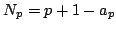
column 5: group structure of 
and here are some initial entries:
0.6576839438 3 -1 5 : cyclic
0.6594793716 1193 -21 1215 : cyclic
0.6755940597 1301 27 1275 : 255 x 5
0.6793569962 1549 -15 1565 : cyclic
0.7005016233 1637 33 1605 : cyclic
0.7059290235 1409 -15 1425 : cyclic
In the last line here, the 1409 indicates that
we are twisting by discriminants divisible by
1409. We found that the proportion of these that
had rank even positive rank is about 0.7059/1409.
The value of  for
for  is -15. The value
of
is -15. The value
of  is 1425. The group of points of
over the finite field of size 1409 is cyclic.
is 1425. The group of points of
over the finite field of size 1409 is cyclic.
Back to the
main index
for Random Matrix Theory and central vanishing of L-functions.