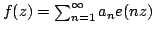
 of weight
  and level
  we can form its
  -function
Given a newform
of weight and level we can form its -function
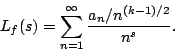 -function satisfies a functional equation
under
-function satisfies a functional equation
under  so that the
  is the center of the critical strip.
Let  be a fundamental discriminant
and let
be a fundamental discriminant
and let  be the real quadratic character
associated with . Thus,
be the real quadratic character
associated with . Thus,  is the Kronecker symbol
 .
Alternatively,
is a real, primitive character with modulus
.
Alternatively,
is a real, primitive character with modulus
 ; this completely specifies except when
 , in which case there are either 0 or 2 such
characters. If we note that is an even character
when
, in which case there are either 0 or 2 such
characters. If we note that is an even character
when  and is odd when
  then the ambiguity is
removed. Finally, we note that
the Dedekind zeta-function associated with the field
then the ambiguity is
removed. Finally, we note that
the Dedekind zeta-function associated with the field
 is given by

We are interested in the order of vanishing of the
quadratic twist
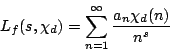

If  is a modular form of weight 2 associated with an
elliptic curve
is a modular form of weight 2 associated with an
elliptic curve  given by
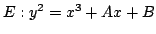 then the -function of
  is
is 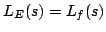 and the
twisted -function
and the
twisted -function
 is just the -function of another
elliptic curve, called the twisted elliptic curve
is just the -function of another
elliptic curve, called the twisted elliptic curve
 . Then our question about the
order of the zero of is, under the
asumption of the Birch and Swinnerton-Dyer conjecture,
the same as the question of the distribution of ranks
in the family
. Then our question about the
order of the zero of is, under the
asumption of the Birch and Swinnerton-Dyer conjecture,
the same as the question of the distribution of ranks
in the family  of twisted elliptic curves
Back to the
main index
for Random Matrix Theory and central vanishing of L-functions.