 be the L-function associated with an elliptic curve of conductor
  . Let
. Let  be the order of vanishing at the center of the critical strip. If RH holds for
  , then
Theorem. Let be the L-function associated with an elliptic curve of conductor . Let be the order of vanishing at the center of the critical strip. If RH holds for , then
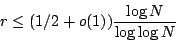
 .
.
Proof.
Let 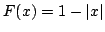 be supported on
 ![$[-1,1]$](img8.gif) .
The Fourier transform of this is
.
The Fourier transform of this is
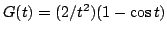 ,
which is everywhere nonnegative. By the explicit formula for this L-function (see page 219 of Mestre), we have
,
which is everywhere nonnegative. By the explicit formula for this L-function (see page 219 of Mestre), we have

 is the Frobenius trace (i.e. minus the coefficient of the logarithmic derivative of . The coefficient is not normalized and so, by Hasse or Weil,
  has size around
  for
for  a prime power.),
 and
and
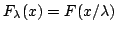 so that
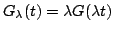 where
where  is a parameter.
The integral tends to
is a parameter.
The integral tends to  as
as
 .
The positivity of
.
The positivity of  (under GRH) and the Weil bound for give
us that
(under GRH) and the Weil bound for give
us that
 ;
the sum is easily bounded by
;
the sum is easily bounded by
 . By taking
 ,
and noting that
,
and noting that  , we thus get that
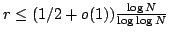 .
.
Back to the
main index
for Random Matrix Theory and central vanishing of L-functions.