
Injective Linear Transformations
Some linear transformations possess one, or both, of two key properties, which go by the names injective and surjective. We will see that they are closely related to ideas like linear independence and spanning, and subspaces like the null space and the column space. In this section we will define an injective linear transformation and analyze the resulting consequences. The next section will do the same for the surjective property. In the final section of this chapter we will see what happens when we have the two properties simultaneously.
As usual, we lead with a definition.
Definition ILT (Injective Linear Transformation) Suppose $\ltdefn{T}{U}{V}$ is a linear transformation. Then $T$ is injective if whenever $\lt{T}{\vect{x}}=\lt{T}{\vect{y}}$, then $\vect{x}=\vect{y}$.
Given an arbitrary function, it is possible for two different inputs to yield the same output (think about the function $f(x)=x^2$ and the inputs $x=3$ and $x=-3$). For an injective function, this never happens. If we have equal outputs ($\lt{T}{\vect{x}}=\lt{T}{\vect{y}}$) then we must have achieved those equal outputs by employing equal inputs ($\vect{x}=\vect{y}$). Some authors prefer the term one-to-one where we use injective, and we will sometimes refer to an injective linear transformation as an injection.
It is perhaps most instructive to examine a linear transformation that is not injective first.
Example NIAQ: Not injective, Archetype Q.
Here's a cartoon of a non-injective linear transformation. Notice that the central feature of this cartoon is that $\lt{T}{\vect{u}}=\vect{v}=\lt{T}{\vect{w}}$. Even though this happens again with some unnamed vectors, it only takes one occurrence to destroy the possibility of injectivity. Note also that the two vectors displayed in the bottom of $V$ have no bearing, either way, on the injectivity of $T$.
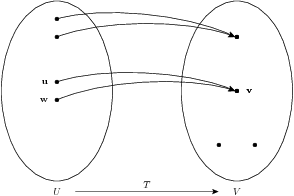
To show that a linear transformation is not injective, it is enough to find a single pair of inputs that get sent to the identical output, as in Example NIAQ. However, to show that a linear transformation is injective we must establish that this coincidence of outputs never occurs. Here is an example that shows how to establish this.
Example IAR: Injective, Archetype R.
Here's the cartoon for an injective linear transformation. It is meant to suggest that we never have two inputs associated with a single output. Again, the two lonely vectors at the bottom of $V$ have no bearing either way on the injectivity of $T$.
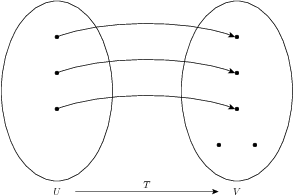
Let's now examine an injective linear transformation between abstract vector spaces.
Example IAV: Injective, Archetype V.
For a linear transformation $\ltdefn{T}{U}{V}$, the kernel is a subset of the domain $U$. Informally, it is the set of all inputs that the transformation sends to the zero vector of the codomain. It will have some natural connections with the null space of a matrix, so we will keep the same notation, and if you think about your objects, then there should be little confusion. Here's the careful definition.
Definition KLT (Kernel of a Linear Transformation) Suppose $\ltdefn{T}{U}{V}$ is a linear transformation. Then the kernel of $T$ is the set \begin{equation*} \krn{T}=\setparts{\vect{u}\in U}{\lt{T}{\vect{u}}=\zerovector} \end{equation*}
Notice that the kernel of $T$ is just the preimage of $\zerovector$, $\preimage{T}{\zerovector}$ (Definition PI). Here's an example.
Example NKAO: Nontrivial kernel, Archetype O.
We know that the span of a set of vectors is always a subspace (Theorem SSS), so the kernel computed in Example NKAO is also a subspace. This is no accident, the kernel of a linear transformation is always a subspace.
Theorem KLTS (Kernel of a Linear Transformation is a Subspace) Suppose that $\ltdefn{T}{U}{V}$ is a linear transformation. Then the kernel of $T$, $\krn{T}$, is a subspace of $U$.
Let's compute another kernel, now that we know in advance that it will be a subspace.
Example TKAP: Trivial kernel, Archetype P.
Our next theorem says that if a preimage is a non-empty set then we can construct it by picking any one element and adding on elements of the kernel.
Theorem KPI (Kernel and Pre-Image) Suppose $\ltdefn{T}{U}{V}$ is a linear transformation and $\vect{v}\in V$. If the preimage $\preimage{T}{\vect{v}}$ is non-empty, and $\vect{u}\in\preimage{T}{\vect{v}}$ then \begin{equation*} \preimage{T}{\vect{v}}= \setparts{\vect{u}+\vect{z}}{\vect{z}\in\krn{T}} =\vect{u}+\krn{T} \end{equation*}
This theorem, and its proof, should remind you very much of Theorem PSPHS. Additionally, you might go back and review Example SPIAS. Can you tell now which is the only preimage to be a subspace?
The next theorem is one we will cite frequently, as it characterizes injections by the size of the kernel.
Theorem KILT (Kernel of an Injective Linear Transformation) Suppose that $\ltdefn{T}{U}{V}$ is a linear transformation. Then $T$ is injective if and only if the kernel of $T$ is trivial, $\krn{T}=\set{\zerovector}$.
Example NIAQR: Not injective, Archetype Q, revisited.
Example NIAO: Not injective, Archetype O.
Example IAP: Injective, Archetype P.
There is a connection between injective linear transformations and linearly independent sets that we will make precise in the next two theorems. However, more informally, we can get a feel for this connection when we think about how each property is defined. A set of vectors is linearly independent if the only relation of linear dependence is the trivial one. A linear transformation is injective if the only way two input vectors can produce the same output is in the trivial way, when both input vectors are equal.
Theorem ILTLI (Injective Linear Transformations and Linear Independence) Suppose that $\ltdefn{T}{U}{V}$ is an injective linear transformation and $S=\set{\vectorlist{u}{t}}$ is a linearly independent subset of $U$. Then $R=\set{\lt{T}{\vect{u}_1},\,\lt{T}{\vect{u}_2},\,\lt{T}{\vect{u}_3},\,\ldots,\,\lt{T}{\vect{u}_t}}$ is a linearly independent subset of $V$.
Theorem ILTB (Injective Linear Transformations and Bases) Suppose that $\ltdefn{T}{U}{V}$ is a linear transformation and $B=\set{\vectorlist{u}{m}}$ is a basis of $U$. Then $T$ is injective if and only if $C=\set{\lt{T}{\vect{u}_1},\,\lt{T}{\vect{u}_2},\,\lt{T}{\vect{u}_3},\,\ldots,\,\lt{T}{\vect{u}_m}}$ is a linearly independent subset of $V$.
Theorem ILTD (Injective Linear Transformations and Dimension) Suppose that $\ltdefn{T}{U}{V}$ is an injective linear transformation. Then $\dimension{U}\leq\dimension{V}$.
Example NIDAU: Not injective by dimension, Archetype U.
Notice that the previous example made no use of the actual formula defining the function. Merely a comparison of the dimensions of the domain and codomain are enough to conclude that the linear transformation is not injective. Archetype M and Archetype N are two more examples of linear transformations that have "big" domains and "small" codomains, resulting in "collisions" of outputs and thus are non-injective linear transformations.
In Subsection LT.NLTFO:Linear Transformations: New Linear Transformations From Old we saw how to combine linear transformations to build new linear transformations, specifically, how to build the composition of two linear transformations (Definition LTC). It will be useful later to know that the composition of injective linear transformations is again injective, so we prove that here.
Theorem CILTI (Composition of Injective Linear Transformations is Injective) Suppose that $\ltdefn{T}{U}{V}$ and $\ltdefn{S}{V}{W}$ are injective linear transformations. Then $\ltdefn{(\compose{S}{T})}{U}{W}$ is an injective linear transformation.